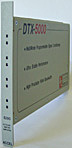
Four Channel Multi-Mode Signal
Conditioner
Description
The 5492 is a multi-mode signal conditioner which combines both constant current and
voltage excitation capability in a single 4 channel module. Combining the features of the
53xx series of instrumentation amplifiers with programmable current sources for use with
IEPE type transducers allows multiple transducer types to be handled by a single module.
This module also includes Programmable Linearized Thermocouple as found in the 5120 (see
specification). The use of programmable excitation voltage sources with the ability to
adjust for DC input offsets gives a complete solution for most sensor types not requiring
bridge completion. TEDS (Transducer Electronics Data Sheet) capability further enhances
system wide integration with the ability to automatically read embedded transducer data
sheets for system level calibration and test setup.
Design Features
The DTX-5492 features 4 individual programmable voltage sources which can be set from
0.01 volts up to 10.00 volts in 10 mV steps alongside 4 individual programmable current
sources, which can be set from 1 mA to 20 mA in 0.1 amp steps while maintaining a full 24V
compliance. In addition, TEDS capability is included for ease of setup and error free
calibrations. Programmable bandpass filtering, automated or manual input bias balance,
AC/DC input coupling, on board NIST traceable calibration and front panel status monitors
are standard features. As with all the DTX-5000 series products, input noise is less than
10µV with full signal bandwidth of 100 kHz.
Programmable Excitation Current
A programmable constant current source provides excitation power for the sensor. A
Digital-to-Analog Converter creates a programmable control voltage that is used to control
the output of current regulator. The current being drawn is sensed and used as a feedback
signal to keep the current constant. Each circuit can provide up to 20 mA of excitation
current with a maximum output voltage of 24V.
Voltage Excitation with AutoZero/AutoGain Capability
The 5492 provides four independent programmable excitation voltage sources for use in
powering input sensors. Each source is controlled by a 16 bit DAC with an output range
from 0 to 10V and 100 mA output buffering. Injecting a programmable offset voltage allows
the DSP to automatically servo the amplifier output to zero adjust any input offset
voltage imbalance. In a like manner, the DSP can adjust the amplifier gain for a targeted
analog output voltage value upon application of a known calibration signal.
Stable Amplifier Circuitry
After AC/DC coupling, the signal is amplified by a fixed-gain precision instrumentation
amp. Using this approach ensures high common-mode rejection to reduce noise pickup on the
sensor wires, and avoids the use of switched gain resistors in the most noise and
temperature sensitive portion of the circuit. Offset adjustment is done after
preamplification to isolate the offset voltage generator from the sensor. A programmable
gain amplifier is then used for additional signal magnification as required by subsequent
processing stages. Precision op-amps and resistors are used throughout all of the analog
circuitry to improve temperature stability.
DSP - Programmable Gain
The variable gain amplifier is controlled by an onboard Digital Signal Processor (DSP)
prior to digitization and subsequent processing. A 16-bit high speed Sigma-Delta converter
is then used to convert the amplifier input to a digitized signal for subsequent
processing. The DSP uses stored offset and gain calibration factors to correct the
digitized data values and generate a digitally filtered output. Digital lowpass filtering
is done by the DSP, providing a better response curve and more flexibility than switched
analog filters. The result is an amplified, error-corrected, and digitally-filtered output
that is ready to be converted back to an analog output voltage.
Output Circuit
The processed digital output is converted back to an analog voltage by a high-speed
16-bit Digital-to-Analog Converter. A four-pole lowpass filter/buffer-amp removes the
digitizing steps in the reconstructed signal, along with any high-frequency noise. As with
the input circuit, temperature-stable components are used to ensure that system
calibration holds over a wide temperature range.
Signal and Status Monitor LEDs
Front-panel LEDs are used to monitor both the signal level and the operating status of
each channel. The DSP compares each digital sample to the level set by the user, and
adjusts the intensity and color of the Signal LED accordingly. The DSP also monitors the
excitation current level and overall digital operation, and sets the color and flash-rate
of the Status LED as needed to warn the user of a problem. |